Why CredOps?
Jan 10, 2026
Why Modern Teams Need CredOps
The Hidden Risk in Every Engineering Team
Every engineering team relies on credentials: API tokens, SSL certificates, OAuth secrets, signing keys, webhooks, passwords, and more. These credentials quietly power production systems—until one day they expire.
When that happens, the failure is rarely graceful.
An API starts returning 401s. A webhook stops firing. A TLS handshake fails. Customers see downtime. Engineers scramble through logs trying to answer the same question:
“Which credential expired… and where is it even used?”
CredOps exists to prevent this exact moment.
Expiring Credentials Are an Operational Problem, Not a Security One
Most teams think of credentials only through a security lens:
Rotate secrets
Lock them down
Store them securely
But expiration is an operations problem.
Credentials don’t fail during business hours with clear alerts. They fail at 2 a.m., during deploys, or in the middle of incidents—because no one was tracking their lifecycle.
What makes this worse:
Credentials live in multiple systems (cloud consoles, SaaS dashboards, CI configs)
Ownership is unclear
Expiry dates are rarely documented
Alerts, if they exist, are scattered or ignored
CredOps treats credentials like production dependencies—because that’s what they are.
What CredOps Does (In One Sentence)
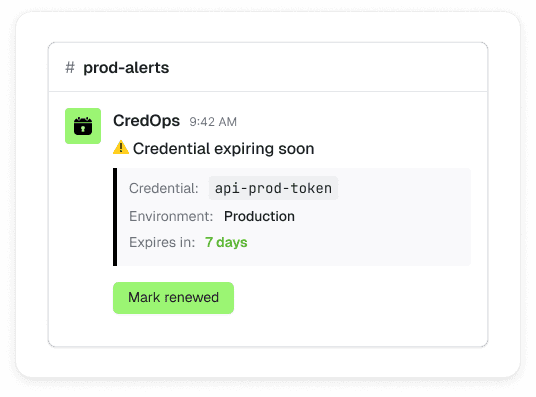
CredOps tracks expiring credentials and notifies your team before they become outages.
The Real-World Problems CredOps Solves
1. No More “Surprise” Expirations
CredOps continuously tracks expiry dates for:
SSL/TLS certificates
API tokens
OAuth credentials
Secrets and keys
You get notified days or weeks in advance, not after something breaks.
2. Alerts Where Teams Actually Pay Attention
Email alerts get ignored.
CredOps sends notifications directly to the tools teams already live in—like Slack—so alerts are:
Visible
Actionable
Shared by the whole team
No more silent failures hidden in inboxes.
3. Clear Ownership and Accountability
Every credential in CredOps has:
A name
An expiry date
When something is about to expire, there’s no guessing about when to fix it.
This alone removes hours of incident-time confusion.
4. Fewer Production Incidents
Credential expirations are entirely preventable outages.
Teams using CredOps eliminate:
Emergency certificate renewals
Broken integrations
Late-night firefighting
It’s not just about alerts—it’s about operational calm.
Why Existing Tools Aren’t Enough
You might already be using:
Password managers
Cloud secret stores
Vaults
These tools are excellent at storage and access control.
They are not designed to:
Track expiry dates across systems
Notify teams ahead of time
Provide a single operational view of credential health
CredOps doesn’t replace your secret store.
It complements it.
Who CredOps Is For
CredOps is built for teams that:
Run production systems
Rely on third-party APIs
Use certificates and tokens extensively
Care about reliability as much as security
This includes:
DevOps and SRE teams
Platform teams
SaaS engineering teams
Growing startups that don’t want growing pains
The Cost of Doing Nothing
Every team eventually learns this lesson the hard way:
Credentials don’t fail often—but when they do, the blast radius is huge.
Downtime, customer impact, incident calls, and lost trust all cost far more than proactive tracking ever will.
CredOps is cheap insurance against an expensive class of failures.
In Summary
CredOps helps teams:
Track expiring credentials
Get notified early
Assign clear ownership
Avoid preventable outages
If your systems depend on credentials—and they do—then you need a way to manage their lifecycle.
CredOps makes credential expiration a non-event.
That’s the goal.